


Concrete & Masonry Services
Concrete and masonry services cover the installation, modification, and maintenance of structural blockwork, foundations, slabs, and related cement-based features for various structures.
4 services · typical 5-step process
What it is
Concrete and masonry tasks encompass the preparation, placement, reinforcement, and long-term care of cementitious assemblies, sub-structures, and stone or block elements. Field contractors frequently analyze ground conditions, erect forms, position reinforcement substrates, and place specialized concrete mixtures designed for various project scopes. Typical project types extend from non-structural exterior flatwork like walkways, terraces, and approaches, to complex foundation stabilization methods and vertical masonry walls. The procedures, tools, and materials chosen generally depend on site layout, soil characteristics, architectural plans, and regional climate patterns.
Services that can fall within Concrete & Masonry
Driveway Pour
Driveway construction services can involve clearing the target perimeter, compacting crushed stone base layers, constructing edge forms, and incorporating steel reinforcement such as rebar or welded mesh. Concrete can be placed, smoothed, textured through methods like brooming, and grooved with tooling joints designed to permit natural material movement under vehicular presence.
Learn morePatio Pour
Patio pours often involve clearing ground vegetation, stabilizing underlying soil, setting perimeter framing, and placing concrete formulated for outdoor foot traffic. Installers can provide decorative treatments such as exposed aggregate, stamped designs, or troweled textures, along with planned relief joints intended to accommodate seasonal temperature variations.
Learn moreCrack Repair
Crack repair services can include clearing debris from separations, grinding channel edges, and applying bonding compounds to masonry assemblies or flatwork. Technicians frequently utilize materials such as urethane foams, epoxy adhesives, or modified cementitious patching mortars to fill open gaps and bridge surface separations across the concrete.
Learn moreFoundation Repair
Foundation services can address shifts, vertical settlement, or bowing in footings and stem walls. Common procedures can involve installing steel push piers, helical anchors, underpinning assemblies, reinforcing interior walls with composite carbon straps, or injecting expanding polymer resins into perimeter fissures.
Learn more
How the work is typically performed
- 1
Site Evaluation and Layout
Technicians typically examine elevations, review regional soil qualities, take measurements across the planned perimeter, and stake out alignment strings. This phase assists in determining slab thickness, reinforcement spacing, and grading configurations suited for surface water transit.
- 2
Sub-Base Excavation and Compaction
Crews typically remove native topsoil to targeted depths and spread crushed stone or gravel. Mechanical plate tampers or rollers are commonly employed to compress aggregate materials into a stable, consistent base layer beneath upcoming concrete pours.
- 3
Formwork and Reinforcement Setup
Carpenters or installers erect perimeter boundaries using timber or metal form boards secured with exterior bracing stakes. Reinforcing materials, including steel grids, fiber additives, or wire mesh panels, are positioned on supports to maintain proper depth within the future pour.
- 4
Pouring and Screeding
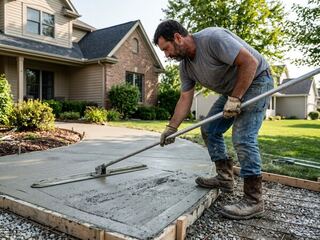
Mixed wet concrete is deposited across the bordered layout, vibrated mechanically to minimize enclosed air pockets, and leveled off using straight screed bars. Hand or power floats are then run across the surface to bring cement paste forward and settle coarse aggregates.
- 5
Finishing and Curing
Installers tool external perimeters, apply selected textures, and score contraction lines into the slab surface. Liquid membrane sealants or moisture-retaining coverings can be added to modulate the evaporation rate while the concrete undergoes its natural hardening phase.
Common reasons customers look for this service
- Noticed shifts or height variations along adjoining concrete slabs
- Desire to install new vehicle parking pads, walkways, or outdoor hardscape additions
- Observation of step cracks or linear fissures across brick, block, or concrete elements
- Changes in surface runoff patterns or soil grading adjacent to perimeter walls
- Presence of surface flaking, pitting, or weathered scaling on older flatwork
About Concrete & Masonry
What factors influence the curing duration for newly poured concrete?
The duration of the curing cycle can vary depending on external temperatures, ambient humidity, mix formulations, and slab dimensions. Mixtures typically transition from a fluid state to an initial hardened state before eventually developing ultimate load capacity through continuous hydration.
What distinguishes minor surface fissures from deeper wall or slab separations?
Fine surface fissures can develop from basic drying shrinkage and superficial moisture evaporation. Broader separations, offset surfaces, or stair-stepped gaps across mortar joints often relate to underlying subgrade displacement, foundation settlement, or lateral earth forces.
What is the function of contraction joints in concrete installations?
Contraction joints serve as planned weak points cut or tooled into slabs at designated intervals. As concrete shrinks and temperature shifts occur, these continuous grooves allow separation to occur neatly along the channel instead of producing irregular cracks across prominent slab surfaces.
This page provides general information about Concrete & Masonry for reference only. It is not professional, safety, medical, legal or financial advice, and it does not describe the services of any particular provider. Scope, methods and timing vary by provider and situation. Kuldesac does not perform these services; contact a qualified provider directly to discuss your specific needs.