


Fencing Services
Fencing services encompass the layout, installation, structural repair, and maintenance of perimeter barriers, privacy screens, and access gates for residential and commercial properties.
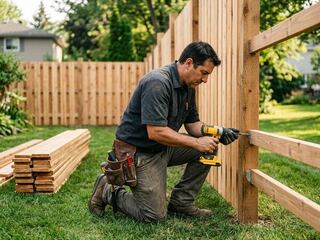
4 services · typical 5-step process
What it is
Fencing covers the construction and upkeep of exterior boundary structures, ranging from below-ground post anchoring and framing to surface board attachment and gate hardware alignment. Service providers often evaluate property contours, soil characteristics, and environmental conditions when planning foundation depths, structural framing materials, and fasteners. The service category includes new installations using natural wood, composite, or synthetic products, as well as targeted maintenance aimed at addressing leaning, weathered, or loose components across existing boundaries.
Services that can fall within Fencing
Wood Fence Install
This service typically involves excavating post holes, setting lumber posts in concrete or gravel, securing horizontal structural rails, and attaching pickets such as cedar, pine, or redwood. Installations can accommodate privacy, shadowbox, or post-and-rail configurations tailored to property contours and grade changes.
Learn moreVinyl Fence Install
Contractors assemble polyvinyl chloride (PVC) systems by anchoring posts and securing pre-routed horizontal rails and interlocking tongue-and-groove pickets. These synthetic systems are manufactured to function without exterior paints or stains and are installed according to manufacturer assembly guidelines.
Learn moreFence Repair
Repair work generally addresses specific physical issues within an existing fence run, such as replacing deteriorated posts, resetting shifted footings, reinforcing cracked rails, or swapping damaged pickets. These tasks focus on vertical alignment and component replacement without necessarily requiring full perimeter replacement.
Learn moreGate Install / Repair
This service involves the installation, adjustment, or refurbishment of swinging or sliding gates. Tasks can include setting dedicated hinge posts, mounting hardware, squaring gate frames, aligning strike latches, and accommodating manual drop rods or mechanical gate operators.
Learn more
How the work is typically performed
- 1
Site Inspection and Layout
Providers map out the designated fence path using stakes and guide lines, identify surface obstacles and elevation changes, and confirm project boundaries prior to excavation.
- 2
Post Hole Excavation
Holes are excavated along the layout line using mechanical augers or manual digging tools, with depths and diameters determined by fence height, post dimensions, and soil conditions.
- 3
Post Setting and Footings
Corner, end, and line posts are positioned, checked for vertical alignment, and set using poured concrete or compacted granular material intended to hold the posts in place.
- 4
Framework and Infill Construction
Horizontal runners or rails are secured between the set posts, followed by the installation of individual pickets, vinyl panels, or modular infill sections using exterior-grade fasteners.
- 5
Hardware Fitting and Alignment
Gates are hung and adjusted for clearance along the ground surface, with hinges, latches, and drop rods aligned to support standard opening and closing movement.
Common reasons customers look for this service
- Visible tilting, shifting, or physical wear on existing posts and footings
- Desire to establish defined property lines, pet enclosures, or visual privacy screening
- Gates dragging along grade, sticking during movement, or failing to engage with latches
- Weathered, split, warped, or missing pickets and structural rails
- Transitioning an existing perimeter barrier to a different material or architectural style
About Fencing
How deep are fence posts typically set into the ground?
Post depth often depends on the height of the fence, soil composition, and regional frost depths. A common guideline involves setting one-third to one-half of the above-ground post height below the surface, frequently ranging from 24 to 36 inches, though specific practices vary by provider and site conditions.
What is the structural difference between wood and vinyl installations?
Wood fences are typically assembled on site from dimensional lumber, with horizontal rails fastened directly to solid wood posts using nails or screws. Vinyl fences commonly utilize factory-fabricated hollow posts with pre-routed openings that receive horizontal rails and interlocking pickets without face-nailing.
How are individual leaning fence posts typically addressed?
Depending on the condition of adjacent panels, technicians often support neighboring sections while excavating and removing the leaning post and its footing. A new post can then be set in fresh concrete or backfill, allowing existing rails and pickets to be reattached if they remain in usable condition.
This page provides general information about Fencing for reference only. It is not professional, safety, medical, legal or financial advice, and it does not describe the services of any particular provider. Scope, methods and timing vary by provider and situation. Kuldesac does not perform these services; contact a qualified provider directly to discuss your specific needs.