


Sprinklers & Irrigation Services
Sprinklers and irrigation services involve the planning, setup, maintenance, and seasonal servicing of outdoor watering equipment for domestic and commercial grounds.
4 services · typical 5-step process
What it is
This service area addresses the underground piping, fluid mechanics, and automated controls that deliver water across lawns, landscaped beds, and planted spaces. Professionals in this sector handle elements such as subterranean supply tubing, zone control valves, electrical signal lines, sprinkler spray bodies, and computerized controllers. Project scopes can involve tasks ranging from locating sub-surface line fractures and replacing malfunctioning heads to engineering extensive zoned watering infrastructure adapted to varied topography.
Services that can fall within Sprinklers & Irrigation
Sprinkler System Repair
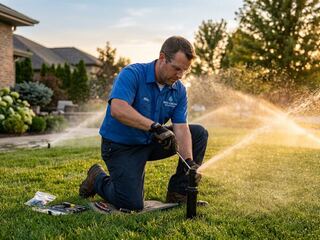
Technicians can assess and service functional components across existing watering setups. Work often encompasses mending broken sub-surface conduits, unblocking spray orifices, servicing solenoid control valves, diagnosing control line continuity, and exchanging damaged rotor or pop-up mechanisms.
Learn moreSprinkler System Install
Installers can configure and bury dedicated watering networks matched to property dimensions, water flow availability, and plant selections. The process can involve subterranean excavation or pipe-pulling techniques, connecting supply junctions, fitting zone manifold assemblies, routing lateral delivery lines, affixing spray components, and wiring centralized timer panels.
Learn moreWinterization / Blowout
Contractors can isolate the main water supply and introduce pressurized air into the lines prior to sub-freezing weather cycles. This procedure is designed to displace residual water from subterranean lines, manifold chambers, backflow devices, and emitter units to limit potential ice-related structural damage.
Learn moreSpring Start-Up
Technicians can recommission inactive watering setups at the onset of warmer months. This service can entail reintroducing water flow at controlled rates, reviewing zone hardware for physical wear, flushing out particulate matter, re-aiming spray patterns, and programming watering schedules into the automated panel.
Learn more
How the work is typically performed
- 1
Hydraulic and Site Evaluation
Technicians often evaluate available water delivery volume, pressure levels, property perimeters, and electrical supply points to outline layout options and hardware configurations.
- 2
Trenching and Pipe Installation
Installers frequently dig narrow paths or use pulling machinery to position distribution piping, supply conduits, and low-voltage control cables below the ground surface.
- 3
Manifold and Head Assembly
Service teams typically mount backflow hardware, set up automated control valves inside subterranean access enclosures, attach riser linkages, and mount pop-up or rotor units.
- 4
Zone Pressurization and Alignment
Technicians often cycle water through sections to clear sediment, verify pressure distribution, and align spray arcs and throw radiuses across targeted turf and planting spaces.
- 5
Controller Setup and Sensor Calibration
Technicians generally secure field wiring to the central control unit, designate watering intervals across zones, and connect precipitation sensors or environmental gauges.
Common reasons customers look for this service
- Damp patches or surface water pooling along subterranean distribution routes
- Spray components failing to rise, turn, or sink into position as expected
- Uneven soil moisture patterns or variable spray throw distances across vegetated spaces
- Preparation for seasonal shutdowns in regions with freezing temperatures
- Seasonal system recommissioning following dormant intervals
- Landscape alterations, turf additions, or plant bed modifications
About Sprinklers & Irrigation
What is the distinction between spray heads and rotor heads?
Spray heads typically produce an uninterrupted, fixed fan pattern suited for smaller or irregular planting zones. Rotor heads generally project turning streams over wider expanses, delivering moisture at different rates depending on nozzle selection and pressure levels.
Why is compressed air commonly utilized during irrigation winterization?
Buried lines often follow natural surface grade changes where water can accumulate in low spots despite gravity drain ports. Applying compressed air is intended to sweep residual fluid through heads and outlets, minimizing the presence of water that could expand upon freezing.
How is the number of watering zones typically determined?
Zoning is often structured by matching available water volume and supply pressure with the requirements of specific head configurations. Property zones may also be grouped according to sun exposure levels, soil drainage characteristics, or differing plant water consumption patterns.
This page provides general information about Sprinklers & Irrigation for reference only. It is not professional, safety, medical, legal or financial advice, and it does not describe the services of any particular provider. Scope, methods and timing vary by provider and situation. Kuldesac does not perform these services; contact a qualified provider directly to discuss your specific needs.