


Sprinkler System Repair
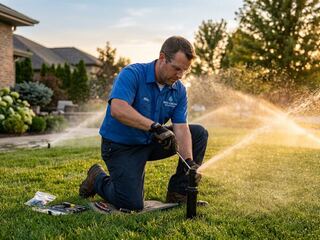
Sprinkler system repair refers to professional services that evaluate, maintain, or replace parts within an established watering network, such as underground piping, control valves, sprinkler bodies, and automated timing units.
6 possible tasks · typical 4-step process
What it is
Sprinkler system repair encompasses technical assessments and physical modifications aimed at addressing mechanical, electrical, or water delivery concerns across an existing irrigation infrastructure. Typical service scopes involve checking subsurface pipe sections, electric manifold assemblies, pop-up spray units, and automated controller units. Technicians can address localized performance variances, altered distribution patterns, or physical component wear without redesigning the entire network layout. Work is generally limited to pre-existing landscape zones rather than comprehensive system installations, main line utility connections, or municipal water modifications.
What Sprinkler System Repair can include
Sprinkler Head Repair and Replacement
Work under this category can involve removing damaged canisters, clearing obstructed nozzles, and substituting worn internal gears or pop-up mechanisms. Service personnel can also modify rotation limits, arc radiuses, and spray trajectories to align water patterns with landscape perimeters.
Underground Pipe Leak Repair
This task can include exposing buried sections of polyvinyl chloride or flexible polyethylene conduit, removing cracked or separated segments, and fitting compatible replacement pipe couplings, sleeves, or solvent-weld joints.
Zone Control Valve Servicing
Technicians can service valve manifolds by disassembling individual units, rinsing internal grit from chambers, swapping deteriorated rubber diaphragms, or fitting replacement electric solenoids and bonnet assemblies.
Irrigation Controller and Wiring Troubleshooting
Service activities can include examining wall-mounted timer terminals, testing communication along multi-strand low-voltage field cables, renewing corroded wire connectors within subterranean access boxes, or replacing malfunctioning electronic control modules.
Pressure Regulation and Flow Optimization
This can involve checking pressure levels across distinct watering zones, integrating inline pressure regulators, inserting pressure-compensating nozzles, or balancing discharge rates among adjacent spray bodies.
Drip Line and Micro-Irrigation Repair
Work in low-volume micro-irrigation zones can encompass mending perforated tubing, clearing clogged point-source drippers, substituting filtration cartridges, and securing flush ends on subsurface or surface-laid distribution lines.
How the work is typically performed
- 1
System Activation and Visual Assessment
A technician typically operates each irrigation zone sequentially via the central controller to observe head extension, watch spray distribution, examine manifold enclosures, and document surface water pooling or reduced output.
- 2
Diagnostic Tracing and Component Isolation
Specialized locating tools, electrical meters, or ground probes may be employed to map buried conduit paths, track broken control wiring, or pinpoint the position of concealed valve housings.
- 3
Physical Excavation and Component Service
Work frequently involves localized turf or soil removal around the target area, extracting compromised pipe sections or malfunctioning valves, securing new fittings, and installing water-resistant electrical fasteners.
- 4
Reactivation and System Calibration
The network is typically reintroduced to water flow to verify connection stability, observe valve closure response, align spray coverage, and update schedule run parameters on the controller.
Common reasons customers look for this service
- Water accumulation on turf surfaces or inside subterranean valve enclosures
- Sprinkler assemblies remaining stuck, failing to rotate, or not retracting below grade
- Uneven moisture distribution or dry patches across designated landscape zones
- Irrigation stations continuing to spray past programmed durations or failing to initiate
- Sprinkler heads emitting high-velocity vapor clouds or demonstrating diminished flow rates
About Sprinkler System Repair
How are underground irrigation line breaks typically accessed and addressed?
Technicians frequently apply targeted detection techniques or electronic line tracers to approximate the location of buried conduit separation. After isolating the area, personnel generally conduct localized excavation to expose the line, remove the compromised material, and insert compatible pipe couplings before restoring the soil layer.
What is typically involved in servicing an irrigation zone control valve?
Valve servicing generally entails opening the subterranean valve housing, disconnecting the low-voltage solenoid, and disassembling the valve cover. Providers can rinse mineral buildup from internal flow ports, place a fresh internal diaphragm, or swap out the entire valve unit if mechanical wear is present.
How is zone pressure regulation typically addressed during irrigation repair?
Technicians can manage line pressure by introducing pressure-regulating stem assemblies directly into sprinkler bodies or attaching an inline regulator at the zone valve manifold. These additions are designed to moderate the water volume and velocity entering the lateral lines, helping standardize spray emission across the designated zone.
This page provides general information about Sprinkler System Repair for reference only. It is not professional, safety, medical, legal or financial advice, and it does not describe the services of any particular provider. Scope, methods and timing vary by provider and situation. Kuldesac does not perform these services; contact a qualified provider directly to discuss your specific needs.