


Smart Lock Install
Installation, alignment, and digital setup of keypad, Wi-Fi, Bluetooth, or smart hub-connected electronic deadbolts and handlesets for exterior and interior doors.
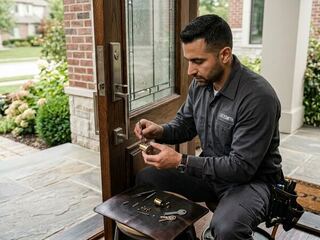
6 possible tasks · typical 5-step process
What it is
Smart lock installation involves replacing conventional mechanical door hardware with automated, electronic, or digital locking devices. The scope of service generally encompasses door and jamb preparation, physical hardware assembly, motorized latch or deadbolt calibration, and electronic pairing to designated networks or smart platforms. Work is typically focused on the lock mechanism and immediate door preparation; it generally does not include structural carpentry, repairs to rotting or significantly warped doors, running mains electrical wiring, or resolving broader network infrastructure issues.
What Smart Lock Install can include
Hardware Removal and Inspection
Disassembly of existing mechanical deadbolts, latches, and strike plates, accompanied by an inspection of door face integrity, backset depth, and jamb condition.
Door and Jamb Modification
Adjusting backset measurements, boring or enlarging cross-bore holes, and chiseling door edges or frame mortises to match specific smart lock chassis dimensions.
Motorized Deadbolt Alignment
Adjusting the latch depth, strike plate orientation, and dust box clearance so the motorized bolt can extend and retract without physical friction against the jamb.
Component Assembly and Wiring
Routing thin electronic data cables through door bores, mounting exterior keypads and interior baseplates, securing connections, and inserting internal battery assemblies.
Network and Ecosystem Pairing
Connecting the hardware to compatible wireless frequencies such as Wi-Fi, Bluetooth, Z-Wave, or Zigbee, which may involve pairing with standalone bridges or smart home controllers.
Access Programming and Testing
Configuring administrative master credentials, programming custom access PINs, verifying emergency key override operation, and checking magnetic or internal door sensors.
How the work is typically performed
- 1
Door and Signal Assessment
Measurements of door thickness, backset, edge bore, and frame clearance are documented, alongside a check of local wireless signal strength at the entryway location.
- 2
Preparation and Retrofitting
Existing mechanical hardware is detached, and the door material may be routed, drilled, or chiseled as needed to allow the new electronic chassis to fit flush against the surface.
- 3
Physical Hardware Mounting
The exterior interface, interior mounting plate, drive cam, and internal cable assemblies are installed, leveled, and fastened to manufacturer torque guidelines.
- 4
Digital Setup and Calibration
Power is connected, the electronic mechanism performs its automated handing sequence to identify left- or right-swing orientation, and wireless integration steps are initiated.
- 5
Operational Validation
The lock is cycled multiple times across available access modes, including keypad inputs, physical key overrides, manual interior thumbturns, and connected mobile interfaces.
Common reasons customers look for this service
- Transitioning from standard mechanical keys to keyless, numeric code, or mobile credential access
- Configuring customized access permissions for visitors, service personnel, or multi-user households
- Replacing older, failing, or incompatible electronic locks with updated smart hardware
- Correcting physical latch binding or deadbolt motor resistance caused by minor door settling
- Adding compatible entryway monitoring and locking mechanisms into a broader automation setup
About Smart Lock Install
Can a smart lock typically be installed on an existing door?
Most residential exterior doors made of wood, fiberglass, or metal with standard cross-bore configurations can support smart lock hardware. When existing preparations are non-standard, offset, or undersized, installation often involves using alignment tools and wood chisels to adjust the bore hole or strike mortise to fit the new device.
How do smart deadbolts typically handle power interruptions?
Battery-powered smart locks generally include visual or audible low-battery notifications well before power is depleted. Many designs retain a standard physical keyway as an analog backup, while certain keyless models feature external electrical terminals that allow a standard 9-volt battery to be held against the housing to provide temporary operational power.
What role does door alignment play in motorized deadbolt operation?
While traditional deadbolts can often be manually forced into the frame by pulling or pushing the door, motorized smart deadbolts rely on low-voltage electric motors. Resistance or friction between the bolt and the strike plate can lead to motor stalling, accelerated battery drainage, or incomplete locking sequences, making precise alignment an important aspect of installation.
This page provides general information about Smart Lock Install for reference only. It is not professional, safety, medical, legal or financial advice, and it does not describe the services of any particular provider. Scope, methods and timing vary by provider and situation. Kuldesac does not perform these services; contact a qualified provider directly to discuss your specific needs.