


Patio Pour
A patio pour encompasses site excavation, the assembly of exterior formwork, and the deposition and finishing of ready-mix concrete to construct ground-level outdoor flatwork.
7 possible tasks · typical 5-step process
What it is
A patio pour involves constructing a flat exterior concrete surface typically intended for open-air seating, dining, or general residential use. The standard scope of work can involve clearing ground vegetation, grading soil, spreading and tamping aggregate underlayment, assembling wooden or composite perimeter framing, laying metal reinforcements, and distributing wet ready-mix material. Finishing phases frequently include smoothing the slab surface, imparting selected textures, and cutting expansion lines to accommodate natural material movement. This service generally focuses solely on flat slab construction rather than overhead carpentry, secondary fencing, privacy screens, masonry retaining structures, or subterranean utility lines.
What Patio Pour can include
Site Excavation and Soil Removal
Can include clearing sod, surface growth, organic topsoil, or older paving to establish an appropriate subgrade depth beneath the planned slab surface.
Subbase Installation and Mechanical Compaction
Can involve laying crushed rock, gravel, or stone base material across the excavation footprint and consolidating it using mechanical tampers or vibratory plates.
Formwork and Slope Setup
Can encompass anchoring lumber or rigid edge forms with stakes along perimeter outlines, aligning elevations to encourage gravity-assisted surface water transit.
Structural Reinforcement Placement
Can involve positioning steel rebar layouts or welded wire fabric elevated on supports inside the form perimeter prior to material deposition.
Concrete Placement and Screeding
Can include discharging mixed wet concrete across the prepared base, spreading it uniformly, tapping down voids, and leveling the profile flush with the perimeter forms.
Surface Floating and Texturing
Can encompass smoothing surface paste with floats, shaping perimeter borders using edging irons, and applying finishes such as broom lines, salt pitting, or exposed aggregate.
Control Joint Installation
Can involve grooving wet concrete with jointers or saw-cutting cured flatwork at set intervals to create predetermined separation channels for standard drying contraction.
How the work is typically performed
- 1
Site Excavation and Subbase Prep
The layout is surveyed and marked with guidelines, after which topsoil, roots, and debris are dug away to the designated depth. Crushed aggregate is then spread across the subgrade and compressed using mechanical compaction machinery.
- 2
Form Building and Reinforcement
Perimeter boundaries are established using wooden or metal boards secured by ground stakes, configured to create an intentional pitch. Reinforcement grids such as rebar or welded mesh are subsequently suspended above the aggregate base on support pedestals.
- 3
Pouring, Consolidation, and Screeding
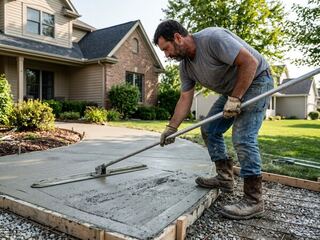
Liquid concrete is transferred from delivery equipment into the framed enclosure, where workers disperse the wet mixture with rakes. Mechanical vibrators or hand tools consolidate the mass, and straight screed bars level the surface with the top edge of the framing.
- 4
Finishing and Joint Cutting
Initial floating brings cement paste to the surface while driving aggregate down. Hand edge tools curve the perimeter corners, after which broom textures or trowel passes are applied, and contraction joints are scored or sawed into the concrete surface.
- 5
Form Stripping and Curing
Perimeter support framing is unfastened and removed following the material's initial hardening phase. The slab is commonly treated with liquid curing sealants, moist coverings, or plastic sheets to support standard cement hydration.
Common reasons customers look for this service
- Developing a dedicated ground-level area for exterior seating, barbecues, or patio furniture
- Replacing older outdoor surfaces that feature substantial surface spalling, uneven settling, or fractured sections
- Switching from elevated wood or composite structures to ground-level flatwork solutions
- Creating solid outdoor walkways or platforms over areas that collect mud or have uneven native soil
- Preparing an even exterior surface designed to support outdoor storage units, fire tables, or cooking equipment
About Patio Pour
What factors influence the general curing progression of a concrete patio?
The progression of concrete curing is largely governed by ambient air temperature, direct sun exposure, wind speed, relative humidity, and specific additives blended into the concrete mix. Project teams typically determine surface readiness for foot traffic and furniture placement based on weather patterns and specific material selections.
What is the function of control joints in outdoor concrete flatwork?
As newly poured concrete cures and sheds hydration water, slight shrinkage naturally occurs throughout the slab. Control joints create intentional lines of reduced thickness that encourage these minor shrinkage fractures to align neatly within the designated grooves rather than appearing across open surface areas.
How is surface water run-off typically directed on a poured patio?
Water routing is normally incorporated during form layout by mounting perimeter forms on a slight downward incline angled away from adjacent exterior walls or foundations. This intentional tilt enables surface rainfall to drain by gravity across the concrete and dissipate into adjacent garden beds or drainage systems.
This page provides general information about Patio Pour for reference only. It is not professional, safety, medical, legal or financial advice, and it does not describe the services of any particular provider. Scope, methods and timing vary by provider and situation. Kuldesac does not perform these services; contact a qualified provider directly to discuss your specific needs.