


Electrical Services
Electrical services cover the assembly, assessment, updating, and maintenance of wiring systems, distribution boards, dedicated pathways, and related power fixtures in domestic and commercial buildings.
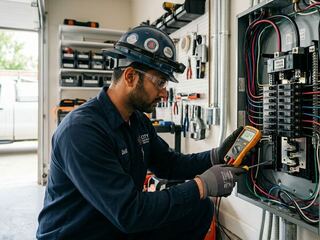
5 services · typical 5-step process
What it is
This category of service pertains to the components and pathways utilized to route and manage electrical power in domestic and commercial structures. Providers typically review load parameters, exchange existing components, establish branch runs, and fit terminal points intended for electricity access. Engagements can involve panel alterations, power supplies for specialized apparatus, system tracing, line revisions, and end-use luminaire or control connections. Depending on the design and characteristics of the property, work can focus on primary service enclosures, conduits, wall devices, outlets, or appliance wiring.
Services that can fall within Electrical
Panel Upgrade
Technicians can replace legacy fuse boxes or older panels with modern breaker enclosures. Work typically encompasses evaluating incoming lines, mounting new enclosures, aligning internal bus bars, and reattaching branch lines to accommodate structural power demand.
Learn moreEV Charger Install
This service can involve setting up a dedicated supply path for electric vehicle charging equipment. The process generally includes fitting dual-pole breakers, routing appropriately sized conduit and wiring, and wiring the charging unit or an associated receptacle.
Learn moreDiagnostic / Troubleshooting
Technicians employ multimeters, tone generators, and circuit tracers to examine wiring networks. This procedure can identify conditions like circuit continuity gaps, disconnected ground paths, voltage irregularities, or unevenly balanced branch circuits.
Learn moreOutlet / Switch Install
Providers place, replace, or reposition wall receptacles, dimmer controls, and specialized interrupting devices. Tasks typically include fitting wall boxes, securing wire connections, verifying terminal alignment, and connecting ground conductors for plug-in devices.
Learn moreLighting / Ceiling Fan Install
Technicians assemble, mount, and wire indoor light fittings, recessed fixtures, exterior luminaires, and ceiling fans. Tasks generally involve reviewing box support capacity, extending switch wiring, and joining leads to allow device operation.
Learn more
How the work is typically performed
- 1
System Review and Layout Planning
Technicians can examine panel configurations, map existing circuit routes, and review estimated electrical draw in relation to planned work.
- 2
Power Disconnection
Electrical supply to the relevant area is turned off at the distribution panel, followed by verification using testing instruments to confirm an inactive circuit.
- 3
Pathway and Enclosure Placement
Technicians mount junction enclosures, arrange conduit runs, guide conductors through wall or ceiling cavities, and anchor cabling along structural members.
- 4
Conductor Termination
Wire ends are prepared, fastened to terminal connections or lugs, and secured to specified torque parameters to establish the conductive path.
- 5
Functional Verification and Labeling
Power is restored to enable checks of line continuity, voltage levels, and device response, alongside noting circuit identities within the panel directory.
Common reasons customers look for this service
- Instances of breaker switches tripping or power pausing across certain circuits
- Plans to incorporate high-demand appliances or vehicle charging stations
- Observations of lighting changes, such as dimming when larger appliances activate
- Interest in updating older two-slot wall sockets to three-slot grounded receptacles
- Discoloration or warmth observed on switch plates or outlet covers
- Renovation projects involving modern lighting layouts or ceiling-mounted fans
About Electrical
What links electrical panel upgrades to EV charging additions?
Dedicated vehicle charging units typically draw notable continuous power. Existing panels may possess restricted breaker capacity or overall load limits, leading property owners to coordinate charger additions with panel updates to support overall building demand.
What is the difference in function between GFCI and AFCI devices?
Ground fault devices monitor current balance across conductors, designed to halt current when path divergence occurs, such as near plumbing fixtures. Arc fault devices are intended to detect distinctive arcing characteristics in a circuit, which can arise from damaged wire insulation or loose connections.
How do junction boxes for ceiling fans differ from standard fixture boxes?
Standard luminaire boxes are engineered to support static hanging fixtures. In contrast, fan-rated boxes are constructed and braced to support continuous motion and the physical weight of an operating fan motor.
This page provides general information about Electrical for reference only. It is not professional, safety, medical, legal or financial advice, and it does not describe the services of any particular provider. Scope, methods and timing vary by provider and situation. Kuldesac does not perform these services; contact a qualified provider directly to discuss your specific needs.