


Septic Services Services
Septic services encompass a range of operational support activities, including waste containment clearance, mechanical evaluations, lateral line flushing, and subterranean dispersal zone management for residential and commercial wastewater configurations.
4 services · typical 5-step process
What it is
On-site wastewater disposal configurations rely on subterranean holding vessels, connecting conduits, and soil absorption fields to process everyday residential or commercial effluent. Professional septic services can include mechanical assessments, removal of settled and floating materials, structural documentation, and distribution system care. Field personnel evaluate component positions, access ports, and perimeter grounds, which can assist in clarifying system layouts and monitoring fluid movement through dispersal routes. Service appointments frequently occur in conjunction with routine property oversight, facility remodeling, planned maintenance schedules, or observed changes in plumbing drainage and surface soil moisture.
Services that can fall within Septic Services
Septic Tank Pumping
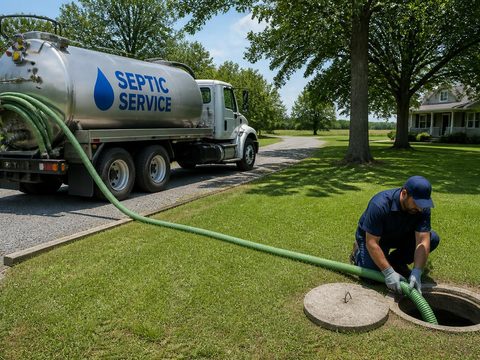
Service crews introduce specialized vacuum lines into access risers or tank ports to draw out accumulated scum layers, liquid effluent, and settled sludge from internal chambers. This extraction process is intended to free up operational volume inside holding vessels, facilitate direct viewing of dividing partitions, and limit the transfer of settleable particles into downstream dispersal areas.
Learn moreSeptic Inspection
Evaluations can involve physical and technical reviews of interior baffles, structural walls, access covers, electrical alarms, and distribution boxes. Providers may use inspection cameras, electronic locators, or water-flow observations to record the condition of access hardware, examine flow paths, and document absorption patterns in the surrounding soil zone.
Learn moreDrain Field Repair
Technicians can evaluate, flush, adjust, or alter subterranean distribution conduits, gravel trenches, modular chambers, and flow-splitting boxes. Service methods can include pressurized water flushing of perforated lateral lines, leveling distribution manifolds, alternating absorption sections, or adding supplementary piping runs to assist fluid dispersion.
Learn moreEmergency Septic Service
Unscheduled service calls typically respond to unexpected disruptions, such as sudden interior drainage slowdowns, electrical alert notifications, or surface pooling near tank areas. Common tasks can involve pumping containment chambers, clearing pipe obstructions, reviewing float mechanisms, or managing fluid accumulation while additional evaluations are planned.
Learn more
How the work is typically performed
- 1
Access and Excavation
Technicians identify buried tank covers, observation ports, and distribution junctions using property plans, electronic sensors, or soil probes, clearing overlying ground cover to access chamber openings.
- 2
Diagnostic Level Check
Service providers observe the relative depths of floating scum, middle liquid, and settled solids relative to inlet and outlet tees to note fluid levels and standard flow patterns.
- 3
Tank Evacuation and Agitation
Hoses connected to mobile vacuum units extract contents from individual compartments, while personnel may introduce water streams or mechanical tools to loosen dense settled layers on the chamber floor.
- 4
Component Servicing and Jetting
Workers rinse removable filter units, observe inlet and outlet baffle conditions, and may guide pressurized water through connecting conduits to clear loose material from pipe interiors.
- 5
Verification and Securing
Personnel observe drainage movement through open access ports, replace and fasten chamber covers or risers, and replace displaced turf or soil across opened sites.
Common reasons customers look for this service
- Audible gurgling or bubbling sounds noted in interior plumbing fixtures during routine water drainage
- Prolonged drainage observed across several plumbing fixtures within a home or commercial building
- Sewer-like odors noted in outdoor areas near holding tanks or soil dispersal areas
- Spongy ground, standing surface water, or noticeable changes in grass coloration over dispersal lines
- Fluid accumulation observed in lower-level plumbing fixtures or basement floor openings
- Scheduled real estate inspections, property boundary reviews, or municipal documentation transfers
About Septic Services
What does an on-site septic evaluation typically entail?
An on-site evaluation typically involves reviewing the physical condition of the holding vessel, measuring internal scum and sludge depths, checking intake and outlet baffles, and observing distribution junctions. Technicians may also observe surface conditions across the absorption area and track fluid flow through accessible observation ports.
What does effluent filter maintenance typically involve?
Effluent filter maintenance can involve extracting the filter core from the outlet baffle housing, spraying collected debris back into the primary containment chamber with a directed water stream, reviewing the casing for physical wear, and reseating the assembly into its operating position.
How is high-pressure hydro-jetting utilized during septic servicing?
Hydro-jetting involves guiding flexible hoses with specialized nozzle tips through transport conduits or perforated lateral pipes. The pressurized water streams can assist in clearing accumulated sediment and organic buildup from pipe interiors, moving loose matter toward access chambers for extraction.
This page provides general information about Septic Services for reference only. It is not professional, safety, medical, legal or financial advice, and it does not describe the services of any particular provider. Scope, methods and timing vary by provider and situation. Kuldesac does not perform these services; contact a qualified provider directly to discuss your specific needs.