


New Door Install
A new garage door installation involves replacing an existing overhead door assembly or outfitting a newly constructed building with fitted panels, counterbalance hardware, tracks, and related operational components.
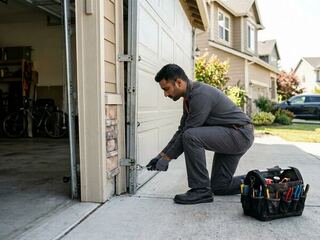
6 possible tasks · typical 5-step process
What it is
A new garage door installation typically encompasses the assembly and mechanical placement of an overhead sectional or roll-up garage door system. This process generally involves positioning tracks, counterbalance springs, rollers, hinges, and perimeter weather seals. Service providers typically evaluate the opening alignment, attach support brackets to surrounding framing, and balance the spring system to assist manual or automated movement. This service generally focuses on standard opening hardware and standard components, while major structural alterations to building framing, dedicated electrical circuit installation, or significant exterior carpentry typically fall outside the scope of a basic installation project.
What New Door Install can include
Removal and Haul-Away of Old Doors
Service providers can relieve tension from existing springs, take apart legacy panels and hardware, and haul away discarded components and metal scrap from the work area.
Track and Hardware Assembly
Installers typically measure, align, and mount vertical and horizontal tracks to the jambs and ceiling supports, positioning them to guide panel movement.
Panel Stacking and Hinge Installation
Door sections are placed incrementally into the track system, secured with mechanical hinges, and fitted with appropriate rollers to facilitate travel along the tracks.
Counterbalance System Setup
Installers can mount torsion or extension mechanisms, including shafts, drums, and lift cables, adjusting spring tension intended to offset the weight of the assembled door sections.
Weatherstripping and Perimeter Sealing
The service often includes fitting a flexible astragal seal along the bottom edge of the lower panel and adding exterior vinyl weatherstripping along the side and top jambs to help limit air and debris infiltration.
Opener Integration and Sensor Alignment
Technicians can connect the assembled door to a compatible motorized opener mechanism and position photoelectric sensors and wall controls according to manufacturer layout specifications.
How the work is typically performed
- 1
Rough Opening Inspection and Prep
The installer typically reviews the dimensions of the opening, measuring headroom, side room, back room, and the level of the floor surface to verify compatibility with the selected door system.
- 2
Tear-Down and Track Mounting
When replacing an existing door, old components are disassembled before vertical and horizontal track sections are positioned, squared, and fastened to adjacent wood or steel framing.
- 3
Panel Placement and Reinforcement
Panels are set into position sequentially from bottom to top, with hinges, rollers, and optional horizontal reinforcement struts attached to support panel rigidity during motion.
- 4
Spring Winding and Cable Attachment
The counterbalance assembly is installed above or beside the opening, lift cables are connected to the lower fixtures, and tension is applied to the springs to support the door's mechanical balance.
- 5
Operational Testing and Safety Calibration
The unit is tested through manual cycles to review track clearance and balance, then connected to an automatic operator if applicable, where travel limits and basic sensor responses are observed.
Common reasons customers look for this service
- Presence of structural damage, cracking, or severe panel wear on an existing assembly
- Updates to aesthetic style, architectural finish, or panel insulation levels
- Mechanical wear, rust, or deterioration observed across tracks, rollers, or counterbalance components
- Outfitting newly constructed garages, workshops, or outbuildings
- Alignment irregularities or persistent friction issues linked to old or non-standard framing track geometry
About New Door Install
What factors determine whether an existing garage door opener can be paired with a new door?
Compatibility can depend on the existing opener's horsepower rating, rail length, drive type, and whether its physical capacity corresponds to the height and overall weight of the replacement panels. A technician can evaluate the operator's condition and mounting hardware to determine if continued use is feasible.
What is the typical time frame for completing a garage door installation?
Installation times can vary based on the dimensions of the opening, the door style, the complexity of the counterbalance system, and site conditions. Many residential installations can take between three and six hours, though custom framing adaptations or low-headroom configurations may alter project duration.
What is the difference between torsion and extension spring setups?
Torsion spring systems are mounted horizontally on a metal shaft directly above the door opening and operate by twisting to counterbalance the door weight. Extension springs are typically mounted along the upper horizontal tracks and expand and contract along the door travel path. Component selection often depends on available headroom, door specifications, and manufacturer configurations.
This page provides general information about New Door Install for reference only. It is not professional, safety, medical, legal or financial advice, and it does not describe the services of any particular provider. Scope, methods and timing vary by provider and situation. Kuldesac does not perform these services; contact a qualified provider directly to discuss your specific needs.