


Opener Repair / Install
Garage door operator maintenance and installation services address the setup, adjustment, and component renewal of motorized openers, mechanical track apparatus, and associated transmitter interfaces for residential garage overhead systems.
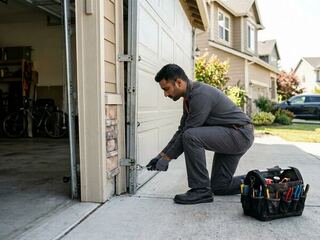
6 possible tasks · typical 5-step process
What it is
This classification of service generally focuses on the mechanical analysis, hardware updating, calibration, and installation of motorized ceiling or wall-mounted openers. Technicians typically handle systems powered by belts, chains, screws, or direct-drive wall configurations. Service tasks can involve internal drive components, receiver boards, wiring, optical alignment components, handheld controls, and track assemblies. The scope is primarily centered on the motorized activation mechanism rather than structural wall carpentry, door framing alterations, or large-scale panel reconstruction.
What Opener Repair / Install can include
Drive Mechanism Repair
Can involve assessing or swapping worn sprockets, nylon drive cogs, flexible belts, roller chains, or screw carriages located within the motor chassis and along the guide rail assembly.
Motor and Logic Board Replacement
Can include evaluating circuit connections, fitting new electronic logic control modules, replacing starting capacitors, or installing full motor assemblies configured to support daily door cycling.
Safety Eye Sensor Realignment and Replacement
Can encompass realigning photo-eye brackets positioned across the lower door track, cleaning transmitter lenses, checking signal wiring integrity, or substituting damaged optical modules.
Full Opener Unit Replacement
Can involve detaching an existing operator chassis and assembling, hanging, and connecting a new ceiling-mounted or wall-mounted overhead door machine.
Limit Switch and Force Adjustment
Can feature configuring mechanical stops or electronic settings to govern open and close travel extents, alongside modifying sensitivity settings that dictate how the machine reacts to ground contact or obstruction.
Accessory Programming and Integration
Can include synchronizing wireless outdoor code pads, portable vehicle remotes, interior consoles, and compatible home network communication interfaces.
How the work is typically performed
- 1
System and Power Inspection
Technicians often begin by reviewing incoming electrical connections, observing status indicator lamps on the logic controller, and disengaging the carriage trolley to review the door's manual movement along the tracks.
- 2
Component Disassembly or Removal
For component servicing, specific elements such as gear kits, electrical capacitors, or terminal connections are accessed and detached. When replacing the complete setup, the motor housing, track sections, and mounting supports are disassembled.
- 3
Mounting and Connection
New drive tracks or replacement operator heads are mounted to structural ceiling supports or adjacent wall studs. Control wiring is routed to the wall station and floor-level optical devices, and primary power connections are completed.
- 4
Travel and Reversal Calibration
Technicians establish upper and lower travel boundaries to align with the door frame and threshold. Optical obstruction response and mechanical contact sensitivity are typically evaluated utilizing standardized testing spacers.
- 5
Transmitter Pairing and Final Cycles
Accessory controllers such as vehicle remotes and wall buttons are paired with the internal receiver. Appropriate lubricant may be applied to designated track sections, followed by multiple complete open-and-close cycles to review overall movement.
Common reasons customers look for this service
- Audible motor humming, buzzing, or clicking without corresponding movement of the door carriage.
- The door changing direction prior to reaching the ground or bouncing upward after contacting the threshold.
- Inconsistent or delayed response to inputs from wall buttons, handheld remotes, or wireless exterior keypads.
- Unusual rattling, slipping, or grinding sounds coming from the drive track or motor casing.
- A desire to transition from an older chain mechanism to a quieter belt design or an internet-connected platform.
- Noticeable physical wear, cracked internal cogs, drooping chains or belts, or damaged low-voltage wiring.
About Opener Repair / Install
What differentiates chain-drive operators from belt-drive units?
Chain-drive units employ a connected metal link assembly along the drive rail, which can produce noticeable operational sound and mechanical vibration. Belt-drive units utilize a reinforced rubber or polymer belt, which typically offers quieter performance. Selection generally depends on homeowner acoustic preferences, room placement relative to the garage, and individual property characteristics.
How does overall door balance interact with motorized operator performance?
Motorized overhead units are typically engineered to move properly balanced doors rather than support unassisted dead weight. During service, the mechanical spring system is often reviewed, as binding rollers or uneven counterbalance can place elevated strain on motor parts. Service descriptions may note the independent movement characteristics of the door assembly.
What does testing of the door reversal features involve?
Technicians typically examine both optical and contact-based reversal features. The optical examination often involves obstructing the infrared signal between the track-mounted sensors during downward travel to observe whether the door stops or reverses. Mechanical testing typically entails setting an object on the floor under the door path to observe how the motor's force settings react. Exact testing methods can vary depending on manufacturer guidelines and the individual technician.
This page provides general information about Opener Repair / Install for reference only. It is not professional, safety, medical, legal or financial advice, and it does not describe the services of any particular provider. Scope, methods and timing vary by provider and situation. Kuldesac does not perform these services; contact a qualified provider directly to discuss your specific needs.