


Wood Fence Install
Wood fence installation encompasses the assembly of outdoor timber enclosures utilizing vertical support posts set in footings, horizontal framing rails, and wooden facing boards designed to outline perimeter boundaries or offer visual separation.
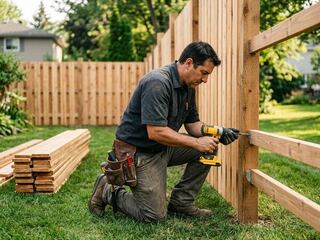
7 possible tasks · typical 5-step process
What it is
This service covers the construction and fitting of various timber fence configurations for domestic or commercial spaces, which can feature solid privacy designs, overlapping board layouts, spaced picket patterns, or post-and-rail styles. Depending on site characteristics and provider scope, projects can entail boundary line marking, post cavity excavation, footing placement with concrete mixtures, structural rail attachment, and entry gate installation. Associated services generally do not incorporate formal property boundary surveys, earth-retaining structural engineering, major vegetative clearing, or post-construction staining and sealing unless specified in the project agreement.
What Wood Fence Install can include
Perimeter Layout and Line Staking
Installers often establish string lines or reference stakes along the planned fence path to outline alignment, identify corner junctions, and plan support post placement.
Post-Hole Excavation
This step entails boring or digging subterranean openings along the fence route, with depths tailored to soil texture and local environmental factors.
Post Setting and Concrete Anchoring
Timber posts, frequently sourced from treated softwood or cedar, are vertically positioned within excavated holes and stabilized by surrounding concrete footings.
Horizontal Rail Framework
Longitudinal structural rails are attached across the vertical posts using exterior-grade fasteners or metal connector plates to form the core supporting framework.
Picket and Board Installation
Vertical cladding boards or decorative pickets, such as cedar, pine, or redwood elements, are secured to the horizontal framework with corrosion-resistant fasteners.
Custom Gate Fabrication
Field construction can involve crafting hinged pedestrian or vehicle access panels on site, complete with diagonal support framing, latching mechanisms, and mounting hardware.
Rot Board and Post Cap Installation
Projects may feature optional bottom sacrificial boards mounted along the ground plane, alongside ornamental or protective toppers positioned on exposed post tops.
How the work is typically performed
- 1
Site Inspection and Underground Utility Verification
Installers typically evaluate the designated perimeter alignment, observe topographical elevation shifts across the property, and review marked underground utility paths prior to breaking ground.
- 2
Excavation and Post Placement
Openings are bored along the intended alignment, crushed stone is sometimes placed in the base for moisture dissipation, and vertical posts are aligned before concrete is introduced.
- 3
Structural Framing and Railing
Following the setting of post footings, horizontal framing runners are attached between structural posts, adapting to terrain contours via stepped or inclined construction techniques.
- 4
Infill Attachment and Picket Spacing
Facing components are fastened to the framework in arrangements matching the chosen aesthetic, such as uninterrupted privacy screens, spaced picket runs, or alternating shadowbox patterns.
- 5
Gate Construction and Final Adjustment
Access gates are constructed, mounted on exterior-rated hardware, and adjusted to facilitate operational alignment and latch engagement.
Common reasons customers look for this service
- Establishing physical property line delineation for residential or commercial land parcels
- Replacing aged, weathered, or compromised existing wooden fencing structures
- Creating defined outdoor zones for visual separation or property partitioning
- Introducing landscape screening around patios, outdoor living spaces, or equipment areas
- Altering property aesthetics through updated fencing styles, lumber selections, or perimeter designs
About Wood Fence Install
What lumber varieties are commonly utilized for timber fencing?
Western red cedar, redwood, and pressure-treated pine represent widely utilized wood varieties. Cedar and redwood are frequently selected for facing materials due to grain patterns and dimensional stability, whereas pressure-treated timber is often chosen for subterranean posts and structural framing elements.
How deep are vertical fence posts typically positioned?
The embedding depth for fence posts can vary depending on overall fence height, ground composition, and regional frost depth patterns. Installers generally establish post depth in proportion to the total height of the fence and the characteristics of the local soil.
How can wood fencing accommodate properties with changing grades?
Terrain variations are commonly addressed using either stepped or racked construction methods. Stepped approaches keep horizontal rails level while creating stepped elevation intervals along an incline, whereas racked installations position rails and pickets to follow the continuous contour of the slope.
This page provides general information about Wood Fence Install for reference only. It is not professional, safety, medical, legal or financial advice, and it does not describe the services of any particular provider. Scope, methods and timing vary by provider and situation. Kuldesac does not perform these services; contact a qualified provider directly to discuss your specific needs.