


Tree Service Services
Tree service encompasses arboricultural care, canopy pruning, sectional tree dismantling, stump grinding, and the clearing of storm-related wood debris for residential and commercial properties.
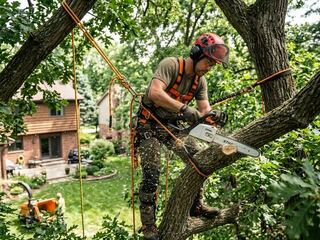
4 services · typical 5-step process
What it is
Tree service involves the management, structural maintenance, and mechanical removal of woody vegetation to address physical clearances, property aesthetics, and environmental conditions. Service providers often utilize aerial access machinery, structural rigging equipment, and specialized cutting tools to manage canopy density, address limb structure, and navigate physical access constraints. The overall scope can span routine canopy maintenance, subsurface stump grinding, and the clearing of storm-displaced vegetation around buildings, fences, driveways, and utility corridors.
Services that can fall within Tree Service
Trimming / Pruning
Trimming and pruning involve cutting selected branches to alter canopy form, address dead or deteriorated wood, and provide physical clearance from buildings, pathways, and overhead lines. Technicians may perform crown thinning, deadwood removal, crown raising, and directional reduction using commercial hand tools, pole saws, or chainsaws designed for arboricultural work.
Learn moreTree Removal
Tree removal is the dismantling and extraction of trees that are declining, structurally compromised, dead, or located within planned construction footprints. Technicians typically use sectional dismantling techniques, employing rigging lines, lowering devices, cranes, or aerial lifts to manage limbs and trunk sections piece by piece in confined spaces near structures.
Learn moreStump Grinding
Stump grinding uses mechanical machinery equipped with rotating cutting wheels to chip the remaining tree base and surface roots down below the surrounding soil grade. This process is intended to reduce above-ground obstacles, minimize the presence of surface wood, and prepare the immediate ground for potential backfilling, turf establishment, or replanting.
Learn moreStorm / Emergency Removal
Storm and emergency removal involves addressing fallen, split, or leaning trees and suspended limbs following severe weather events such as high winds or ice accumulation. Crews may secure shifting material with winches or rigging equipment, section fallen or uprooted trees, and clear debris from access routes, driveways, or structures.
Learn more
How the work is typically performed
- 1
Site Inspection and Assessment
Technicians evaluate the tree species, canopy structure, surrounding physical space, and potential drop zones to select suitable cutting techniques and access equipment.
- 2
Work Zone Setup and Rigging
Crews delineate ground perimeters and may install climbing lines, friction devices, and overhead lowering blocks within stable canopy sections or on external support systems.
- 3
Canopy Work and Sectional Cutting
Personnel access the canopy via climbing systems or aerial lifts to make pruning cuts or dismantle trunk sections, often using guided ropes to direct pieces to the ground.
- 4
Debris Processing and Chipping
Ground personnel feed cut brush and branches into mechanical chippers, cut larger trunk sections into manageable logs, and collect loose sawdust and organic material.
- 5
Stump Grinding and Site Remediation
When requested, technicians use grinding equipment to reduce the stump below ground level, rake wood mulch into the depression, and complete basic cleanup of the immediate area.
Common reasons customers look for this service
- Branches growing close to rooflines, exterior siding, chimneys, or utility service connections
- Visible hollows, fungal growth, or detached bark along the main trunk or scaffold limbs
- Co-dominant stems exhibiting visible vertical splits or inward bark unions
- Uprooted soil plates or noticeable trunk lean following periods of high wind or saturated earth
- Accumulations of dead, broken, or unattached limbs within the upper canopy
- Clearing needs associated with planned construction, driveway installation, or underground utility work
About Tree Service
What is the operational difference between stump grinding and complete stump removal?
Stump grinding utilizes rotating cutting teeth to chip the visible tree base down several inches below the surrounding soil level, leaving the deeper root system to decompose over time. Complete stump removal typically involves excavation equipment to extract the entire root ball from the soil, which creates a larger ground void that generally requires backfilling.
How are trees dismantled in confined spaces or near structures?
In restricted areas, technicians typically employ sectional dismantling techniques. Limbs and trunk segments are cut into smaller sections and lowered using controlled rigging lines, pulleys, and friction devices. In some settings, cranes or aerial lift units may be used to lift and transfer cut sections directly to a designated ground staging zone.
When is tree pruning typically performed during the year?
Pruning schedules can vary depending on the tree species, local climate, and specific landscaping objectives. Structural pruning is often scheduled during the dormant period in late winter, when branching form is visible and deciduous trees are not actively growing. General maintenance or branch clearing can occur at various times throughout the year depending on site requirements and provider availability.
This page provides general information about Tree Service for reference only. It is not professional, safety, medical, legal or financial advice, and it does not describe the services of any particular provider. Scope, methods and timing vary by provider and situation. Kuldesac does not perform these services; contact a qualified provider directly to discuss your specific needs.