


Dryer Vent Cleaning Services
Dryer vent cleaning involves removing lint, dust, and particulate buildup from exhaust ductwork, as well as addressing duct runs or transitions intended to support dryer exhaust airflow.
2 services · typical 5-step process
What it is
Dryer vent cleaning encompasses the inspection, mechanical clearing, and general physical maintenance of exhaust systems connecting clothes dryers to outdoor termination points. Service providers typically inspect the ventilation path, targeting accumulated lint, foreign obstructions, and misaligned or restricted duct sections. These services are intended to facilitate airflow through the exhaust line, manage operational friction within duct components, and help maintain unobstructed exhaust pathways across residential and commercial properties.
Services that can fall within Dryer Vent Cleaning
Residential Vent Cleaning
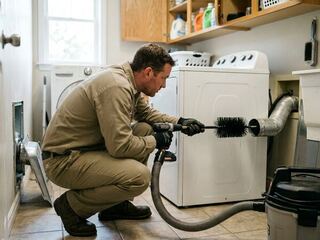
This service can involve using tools such as rotary brushes, air whips, or vacuum systems to dislodge and collect lint, dust, and debris throughout the length of an exhaust line. The scope can include the flexible transition piece behind the appliance, concealed duct runs traversing walls, floors, or attic spaces, and the exterior termination cap.
Learn moreVent Repair / Reroute
This service can encompass identifying and addressing disconnected, crushed, or degraded duct sections, as well as modifying pathways that feature multiple turns or extended lengths. Providers may replace flexible transition hoses with semi-rigid or rigid metal ducting, apply sealant or foil tape at connection seams, and arrange runs toward exterior termination points.
Learn more
How the work is typically performed
- 1
Initial Inspection and Airflow Assessment
Technicians typically conduct a visual review of the accessible duct run, the exterior vent terminal, and the connection behind the appliance. In some cases, airflow velocity or backpressure readings may be taken to assess general movement through the duct.
- 2
Appliance Disconnection and Access Setup
The appliance is typically pulled forward to allow access to the rear exhaust port and the wall transition pipe. The transition duct is temporarily detached so that cleaning equipment can be inserted directly into the main duct line.
- 3
Mechanical Agitation and Debris Extraction
Specialized flexible rods fitted with rotating brushes or compressed air nozzles are generally guided through the interior of the duct run to dislodge accumulated lint. Vacuum systems or negative-pressure collection equipment are often used simultaneously to capture loosened material.
- 4
Exterior Cap and Damper Servicing
Technicians typically examine the exterior termination hood, louvered vent, or damper flap. Built-up lint or exterior debris is cleared, and the damper mechanism is checked to confirm that flaps move freely and close when the appliance is not operating.
- 5
Reconnection and Final Airflow Check
The exhaust transition duct is reattached to the appliance and wall collar, often secured with clamps or foil tape. The appliance is returned to position, and a brief operational test may be conducted to confirm the presence of exhaust airflow at the outdoor termination point.
Common reasons customers look for this service
- Observations of extended drying times during regular laundry cycles
- High heat or moisture levels noticed in the laundry area during dryer operation
- Odors associated with hot lint or stale air detected near the appliance
- Noticeable lint accumulation around the exterior vent cap or surrounding siding
- Exterior vent louvers or flaps that do not appear to open during an active drying cycle
- Periodic property maintenance routines or scheduling after home purchase or renovation
About Dryer Vent Cleaning
What factors influence how frequently dryer exhaust vents are cleaned?
The timing between cleanings can vary depending on household size, frequency of appliance usage, the length and layout of the duct run, and the types of fabrics commonly dried. Service intervals often vary by property and specific usage patterns.
What types of materials are commonly used for dryer exhaust ducting?
Dryer exhaust systems commonly utilize rigid metal piping or semi-rigid metal transitions, which present smooth interior surfaces designed to facilitate exhaust movement. Flexible ribbed foil or plastic materials are also found in some installations, though rigid metal configurations are frequently selected by installers to minimize interior ridges where debris might collect.
How does exhaust duct restriction affect dryer operation?
Restricted airflow typically limits the rate at which hot, moist air escapes the dryer drum. This condition can lead to longer operational cycles and elevated internal temperatures, which can place additional wear on heating elements, thermostats, drive belts, and other internal mechanical parts.
This page provides general information about Dryer Vent Cleaning for reference only. It is not professional, safety, medical, legal or financial advice, and it does not describe the services of any particular provider. Scope, methods and timing vary by provider and situation. Kuldesac does not perform these services; contact a qualified provider directly to discuss your specific needs.