


Driveway Pour
A concrete driveway pour comprises ground preparation, layout framing, structural reinforcing, and the delivery of mixed concrete intended to create an exterior vehicular surface.
7 possible tasks · typical 5-step process
What it is
This category of service generally involves earthwork, boundary framing, placement of internal reinforcement elements, and the casting, consolidation, and surface finishing of an exterior flatwork slab. Driveway installations can take place during initial property construction or as part of remodeling efforts involving the removal of preexisting surfaces. Additional treatments such as asphalt layering, deep structural piering, or post-placement decorative sealers and surface colorings are commonly treated as separate scopes of work depending on project arrangements.
What Driveway Pour can include
Subgrade Excavation and Compaction
Service providers often dig out the designated footprint to a specified depth, clear loose earth and organic material, and apply mechanical compaction equipment to help establish an even soil subgrade under the slab.
Aggregate Base Installation
A granular subbase such as crushed rock or gravel can be spread across the footprint, leveled to assist with water runoff, and compacted to provide uniform physical support for the incoming concrete.
Formwork Construction
Framing materials such as timber boards or metal rails are positioned around the layout boundaries to establish the planned dimensions, elevations, and drainage pitch of the slab.
Structural Reinforcement Placement
Crews often lay out reinforcing materials such as welded steel mesh or deformed rebar grids on spacing chairs, which is intended to add tensile capacity and assist with load distribution across the concrete.
Concrete Placement and Consolidation
Mixed concrete is deposited within the established forms, moved into place across the subbase, and can be consolidated with vibration tools to help limit internal air pockets around the embedded reinforcement.
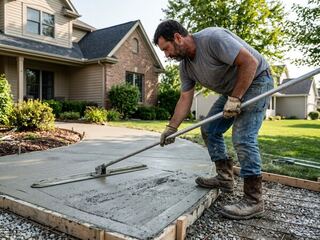
Screeding, Floating, and Texturing
Specialists draw screed boards across the top of the forms to strike off excess material, use floats to level the surface mortar, and frequently run brooms across the exterior to produce a non-smooth surface texture.
Control Joint Installation
Installers frequently hand-tool or saw-cut contraction joints across the slab at regular intervals, creating intentional weak planes intended to direct natural drying shrinkage into uniform lines.
How the work is typically performed
- 1
Site Excavation and Base Preparation
Existing ground or paving materials are cleared away, earth is excavated to the project elevation, and a layer of granular rock is distributed, graded, and mechanically compacted to create a level support surface.
- 2
Formwork and Steel Reinforcing
Perimeter edge forms are anchored to define the slab margins and surface pitch, after which reinforcing elements like steel rebar or wire fabric are raised on supports above the aggregate.
- 3
Discharge and Consolidation
Concrete batch trucks unload the wet mix directly into the framed area, where workers spread the material, consolidate it using specialized tools, and strike it level with the form tops.
- 4
Finishing and Jointing
The upper paste is smoothed using hand or mechanical floats, contraction lines are placed into the slab, and a textured finish is applied across the exposed surface.
- 5
Curing and Stripping
Protective blankets or liquid membrane compounds can be applied over the concrete to help manage moisture retention as the material sets, after which edge boards are disassembled and removed.
Common reasons customers look for this service
- Establishing an initial vehicular approach and parking pad on an undeveloped parcel
- Replacing a deteriorated, fractured, or settled existing driveway
- Upgrading an unpaved dirt or crushed stone path to a solid concrete surface
- Broadening the width or length of an existing driveway to accommodate additional vehicles
- Reconfiguring driveway alignment or surface slope as part of wider landscaping adjustments
About Driveway Pour
How does the concrete curing process typically proceed for a driveway?
The curing timeline can vary according to environmental temperature, moisture levels, and the concrete blend selected. Light surface contact may occur after an initial setting period, while heavier vehicular traffic is commonly postponed until the slab achieves greater internal hardness. Final structural capacity is generally evaluated over an extended period, depending on local conditions and installer methodology.
What is the function of control joints in a concrete driveway pour?
During the hardening phase, concrete naturally contracts as free water evaporates, creating internal tension. Control joints provide designated separation lines across the slab surface, which are intended to influence where shrinkage cracking occurs and keep it within predetermined grooves rather than spreading across the field.
How do rebar and wire mesh differ when used as driveway reinforcement?
Wire mesh consists of thin steel strands welded in a grid pattern, frequently used to assist in holding surface cracks together and maintaining slab integrity. Steel rebar consists of thicker ribbed bars arranged in an interconnected grid, which can provide greater load-bearing reinforcement for slabs subjected to vehicle weights. Selection often depends on ground conditions and engineering plans.
This page provides general information about Driveway Pour for reference only. It is not professional, safety, medical, legal or financial advice, and it does not describe the services of any particular provider. Scope, methods and timing vary by provider and situation. Kuldesac does not perform these services; contact a qualified provider directly to discuss your specific needs.