


Holiday Lighting Services
Holiday lighting covers the installation, maintenance, seasonal removal, and permanent integration of decorative exterior illumination systems for residential and commercial properties.
3 services · typical 5-step process
What it is
This service category typically includes seasonal holiday displays as well as permanent, track-based architectural illumination mounted along rooflines, landscape features, and exterior structures. Providers often work with commercial-grade fixtures, custom-measured wiring, and specialized fasteners suited for temporary or continuous exterior use. Depending on the selected arrangement, services can encompass design planning, elevated placement, ongoing maintenance during the display period, and post-holiday takedown and storage.
Services that can fall within Holiday Lighting
Holiday Light Install
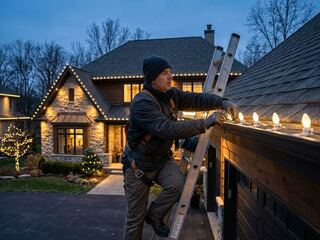
This service can include measuring rooflines, sizing wiring to match building dimensions, and attaching outdoor-rated bulbs to gutters, fascias, or landscaping with surface-appropriate fasteners. Technicians typically connect displays to outdoor power sources, distribute electrical loads across available circuits, configure automated timers, and test the system upon completion.
Learn moreHoliday Light Takedown
Following the seasonal display period, providers can dismantle light strands, temporary clips, extension cords, and timers from architectural features. The service often involves organizing strands by property section, examining hardware for general wear, coiling cables to prevent tangling, and packing materials into protective containers for future use.
Learn morePermanent Lighting Install
Installations can feature low-profile, color-matched tracks containing programmable LED modules mounted beneath roof eaves, soffits, or trim for year-round architectural lighting. The scope typically includes routing weather-rated cabling, installing dedicated control units, and setting up mobile applications or digital controllers for custom color patterns and operational schedules.
Learn more
How the work is typically performed
- 1
Site Inspection and Power Planning
Technicians typically review architectural lines, roof elevations, and landscaping to determine linear footage and fixture quantities. They also identify accessible outdoor electrical receptacles to plan cord routing and distribute power demands across available circuits.
- 2
Custom Assembly and Pre-Installation Testing
Cables may be measured and cut to match the building's specific contours, with custom plugs attached to minimize excess slack. Technicians frequently test bulbs, sockets, and controllers before placement to confirm proper function across all segments.
- 3
Elevated Mounting and Cord Routing
Lighting is affixed along gutters, roof edges, or trim using specialized clips or channel tracks designed for specific architectural surfaces. Extension cords and power leads are typically routed along structural paths, such as downspouts, toward exterior outlets.
- 4
System Configuration and Display Testing
Once positioned, the display is energized to evaluate bulb alignment and verify steady power delivery. Providers often set up mechanical timers, digital controllers, or smart device applications to establish requested operational times and lighting effects.
- 5
Post-Season Removal and Storage
For temporary displays, technicians return after the season to detach fixtures, remove fasteners, and clear exterior surfaces. Components are typically sorted, labeled by installation zone, and packed into storage containers for use in subsequent seasons.
Common reasons customers look for this service
- Properties with multi-story rooflines, high gables, or complex architectural dimensions
- Desire for custom-fitted lighting layouts without visible cord slack or mismatched components
- Transitioning from temporary holiday strings to permanent, app-controlled architectural track lighting
- Preference for scheduled exterior setup, maintenance, and seasonal removal by an outside provider
- Display layouts requiring power distribution across multiple separate exterior electrical circuits
- Assistance with organized post-holiday disassembly, strand labeling, and equipment packing
About Holiday Lighting
What is the difference between temporary and permanent holiday lighting?
Temporary lighting typically involves seasonal strands attached with removable clips for a limited period, followed by post-holiday takedown. Permanent systems utilize low-profile, color-matched tracks housing programmable LEDs installed under eaves or soffits, remaining mounted year-round and operated via digital applications.
Do holiday lighting services include hardware, or can existing lights be used?
Policies can vary by service provider. Many companies furnish commercial-grade wiring, bulbs, and fasteners as part of a comprehensive package, while some providers may agree to install customer-supplied lights depending on equipment condition and compatibility with the planned layout.
How are electrical loads typically managed for exterior lighting displays?
Providers generally evaluate the total wattage demand of the planned fixtures against the capacity of available exterior circuits. By utilizing energy-efficient LED technology and distributing strands among separate receptacles, technicians aim to maintain balanced electrical loads throughout the display period.
This page provides general information about Holiday Lighting for reference only. It is not professional, safety, medical, legal or financial advice, and it does not describe the services of any particular provider. Scope, methods and timing vary by provider and situation. Kuldesac does not perform these services; contact a qualified provider directly to discuss your specific needs.